Introduction
Manufacturing floors and warehouse facilities operate at a pace where every second of downtime carries a measurable cost. In these environments, communication cannot afford to be slow, fragmented, or buried in an email inbox that no one on the shop floor checks. Workers need immediate, visual, and context-aware information delivered exactly where they are standing.
Digital signage has emerged as one of the most effective tools for closing this communication gap. Unlike static bulletin boards or printed schedules that become obsolete the moment they are pinned up, networked displays can push live updates, safety alerts, production dashboards, and training reminders to every corner of a facility within seconds. For operations managers overseeing large footprints with multiple shifts, this capability is not a convenience. It is a structural advantage.
This article examines how manufacturing and warehouse operations use digital signage to improve safety outcomes, increase operational visibility, and reduce the communication friction that slows down high-velocity work environments.
The Communication Problem on the Shop Floor
Industrial facilities face a specific set of communication challenges that office-based teams rarely encounter. First, the workforce is often distributed across vast physical areas. A single warehouse may span hundreds of thousands of square feet with loading docks, mezzanines, cold storage zones, and assembly lines separated by considerable distance. Second, many employees do not have desks, company email access, or regular interaction with enterprise software. They rely on verbal briefings, printed notices, or word-of-mouth to stay informed. Third, shift work means that not everyone attends the same stand-up meetings. A night crew may start their work with little overlap with day management, creating information asymmetry that leads to errors and delays.
Static signage has been the default solution for decades, but it fails on every important dimension. It is slow to update, costly to reprint, impossible to target by zone or shift, and offers no feedback loop to confirm that a message was ever seen. Digital signage replaces this brittle system with a live, programmable, and measurable communication layer.
Safety Alerts and Real-Time Hazard Communication
Safety is the highest-priority use case for digital signage in manufacturing and warehousing. Regulatory bodies require facilities to post hazard warnings, personal protective equipment requirements, and incident notifications in visible locations. Traditional methods involve printed posters and laminated sheets that are easy to ignore, difficult to update, and nearly impossible to track.
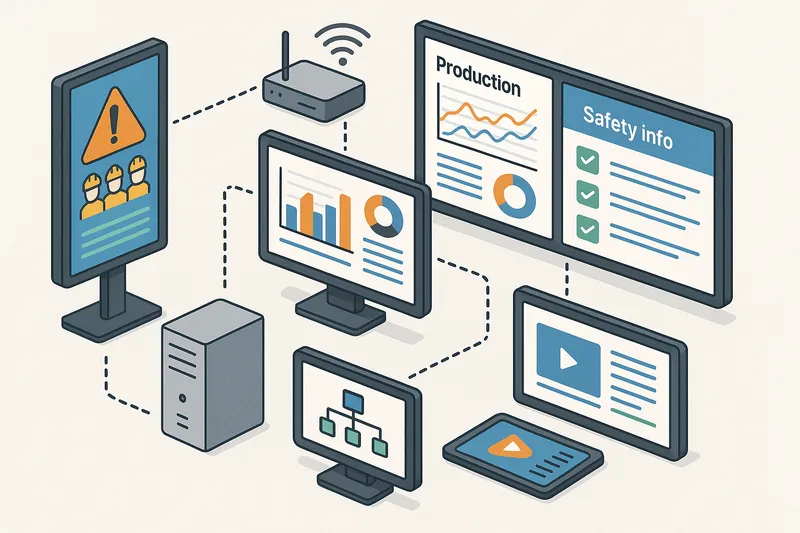
Digital displays change the equation by allowing safety teams to push alerts instantly. If a spill occurs in aisle twelve, a targeted message can appear on screens near that zone within seconds. If air quality monitoring detects an anomaly, every display in the affected wing can switch to a full-screen warning with evacuation instructions. Because modern content management systems support zone-based targeting, the message reaches only the people who need to see it rather than triggering unnecessary alarms across the entire facility.
The visual format also matters. Motion and color contrast attract attention in noisy environments where auditory announcements might be missed. A flashing amber banner with a clear icon and concise instruction cuts through the ambient distraction of machinery, forklifts, and ventilation systems. Safety managers can also schedule recurring reminders before high-risk periods, such as seasonal heat warnings or increased forklift traffic during receiving windows.
Beyond reactive alerts, digital signage supports proactive safety culture. Screens can rotate through daily safety tips, incident-free day counters, near-miss reporting prompts, and compliance checklists. When safety messaging is embedded into the visual environment rather than isolated on a single bulletin board, it becomes part of the operational rhythm rather than an afterthought.
One of the most powerful applications of digital signage in manufacturing is the real-time display of production key performance indicators. Operations managers have long relied on whiteboards and manual tally sheets to track output, defect rates, machine uptime, and order progress. These manual systems are inaccurate, delayed, and demotivating. By the time a number is written on a board, it is already outdated.
Digital KPI dashboards connected to manufacturing execution systems or enterprise resource planning platforms can show live metrics without manual intervention. A screen above an assembly line might display the current shift target, units completed, average cycle time, and quality pass rate. A display in the plant manager’s office might aggregate data from multiple lines to show overall equipment effectiveness across the entire facility.
The psychological impact of public performance visibility is significant. When teams can see their progress against a target in real time, the feedback loop tightens. Small delays become visible immediately rather than surfacing hours later during a post-shift review. Operators can self-correct pacing before a deficit becomes critical. Supervisors can spot bottlenecks as they form rather than reconstructing them from historical reports.
The key to effective dashboard design is restraint. Manufacturing floors are already visually dense environments. A display that tries to show twenty metrics at once will be ignored. The best practice is to limit each screen to three or four critical numbers with clear visual hierarchy. Red, amber, and green status indicators should be large enough to read from across the floor. Context matters: a packing station needs different metrics than a machining center, so content should be tailored by location rather than broadcast uniformly.
Wayfinding and Zone Management
Large manufacturing and warehouse facilities suffer from navigation friction. New employees, temporary workers, and visiting contractors often struggle to locate specific bays, picking zones, or restricted areas. Poor wayfinding wastes labor hours, increases safety risk, and creates frustration.
Digital signage can serve as a dynamic wayfinding layer. Interactive kiosks near entrances allow visitors to search for a destination and receive visual directions. Non-interactive displays mounted at corridor intersections can show zone maps, current occupancy levels, or traffic flow instructions during peak periods. During emergencies, these same screens can switch to evacuation routes with real-time updates based on incident location.
Zone management extends beyond navigation. In facilities with temperature-controlled storage, clean rooms, or hazardous material areas, digital displays can show current environmental conditions, access requirements, and occupancy limits. If a zone requires special credentials or personal protective equipment, the screen can reinforce those rules at the point of entry rather than relying on distant signage that workers may have already forgotten.
Dynamic wayfinding also supports operational changes. When a warehouse reconfigures its layout for seasonal volume, digital maps can be updated in minutes rather than waiting for new printed materials. When a manufacturing line is repurposed for a different product, signage can reflect the new workflow without replacing physical labels.
Training Reinforcement and Compliance Visibility
Training in industrial environments is not a one-time event. It is a continuous process of reinforcement. Safety certifications expire. Equipment procedures are updated. Quality standards evolve. Employees who were trained six months ago may have faded recall on specific protocols.
Digital signage extends the training function into the work environment itself. Short video loops demonstrating proper lifting technique, lockout-tagout procedures, or quality inspection checkpoints can play on break-room screens and near relevant workstations. Micro-learning delivered in thirty-second segments at the point of need is more effective than annual classroom sessions that employees struggle to remember.
Compliance visibility is another critical function. Regulatory audits often require proof that policies were posted and accessible. Digital signage systems provide timestamped logs of what content played, where, and for how long. This audit trail is stronger evidence than a photograph of a static poster that could have been installed the day before the inspector arrived.
Content managers can also schedule compliance messaging to align with audit windows or certification renewal cycles. When a food processing facility approaches a sanitation audit, screens can emphasize hygiene protocols, temperature logging requirements, and allergen control measures. When a chemical plant faces an environmental inspection, displays can highlight spill containment procedures and reporting chains.
Emergency Mass Notification
Manufacturing and warehouse facilities must be prepared for emergencies including fires, chemical releases, severe weather, and security threats. The ability to communicate rapidly with every person in the building can determine whether an incident is contained or becomes catastrophic.
Digital signage serves as a visual mass notification channel that complements sirens and public address systems. In loud environments where spoken announcements may be inaudible, a full-screen visual alert with bold text and color coding provides redundant clarity. Screens can show evacuation maps, assembly point locations, shelter-in-place instructions, or all-clear notices.
Modern content management platforms allow emergency content to override all scheduled programming instantly. A safety officer can trigger a facility-wide alert from a mobile device without navigating through complex publishing workflows. Zone-based targeting ensures that different areas receive appropriate instructions. A loading dock might need to secure trailers before evacuating, while an office wing simply needs to exit. The ability to customize messaging by location and threat type turns generic alarms into actionable guidance.
Implementation Considerations for Industrial Environments
Deploying digital signage in manufacturing and warehouse settings requires different hardware and network planning than an office lobby deployment. The physical environment is harsher. Temperature swings, dust, vibration, and moisture are common. Standard consumer displays are not designed for these conditions and will fail prematurely.
Commercial or industrial-grade screens with appropriate ingress protection ratings, wide temperature operating ranges, and vibration-resistant mounting should be specified. In high-bay warehouses with direct sunlight, brightness levels of one thousand nits or higher may be necessary for readability. In food processing or pharmaceutical facilities, displays may need sealed enclosures that allow washdown cleaning without moisture intrusion.
Network connectivity is another variable. Some facilities have robust wired ethernet infrastructure. Others rely on wireless mesh networks that must support reliable streaming across metal-rich environments that interfere with radio signals. Offline playback capability is essential. If a display loses connectivity, it should continue showing relevant content rather than a blank screen or error message. The content management platform should support local caching and automatic recovery when the network returns.
Power stability matters. Industrial environments experience voltage fluctuations that can damage consumer electronics. Displays should be connected through uninterruptible power supplies or power conditioners. Auto-restart functionality ensures that if a screen loses power during a brief outage, it resumes operation without manual intervention.
Finally, content management at scale requires role-based access. A plant manager, a safety coordinator, and a corporate communications team should each have permissions appropriate to their responsibilities. The safety officer should be able to push emergency alerts without needing IT approval. The operations team should be able to update KPI dashboards without granting them access to brand messaging templates. Separation of duties prevents both bottlenecks and accidents.
Measuring Impact and Return on Investment
The business case for digital signage in manufacturing should be grounded in measurable outcomes rather than aesthetic preference. Safety metrics are the most concrete starting point. Facilities can track incident rates, near-miss reports, and safety audit findings before and after digital signage deployment. If safety alerts and training reinforcement reduce lost-time incidents by even a modest percentage, the financial return exceeds the technology investment.
Operational efficiency metrics provide another angle. Compare production throughput, defect rates, and changeover times between lines that have digital KPI visibility and those that do not. Measure the time saved by eliminating manual whiteboard updates. Track the reduction in mis-picks or shipping errors in warehouses that deploy dynamic picking lists and zone instructions.
Communication efficiency is harder to quantify but still observable. Survey employees on their confidence in knowing current priorities and safety requirements. Measure the time required to disseminate policy changes or production schedule adjustments. In organizations where information previously took hours or days to cascade, digital signage can compress that timeline to minutes.
Total cost of ownership calculations should account for hardware lifespan, software licensing, content creation labor, and network infrastructure. Industrial deployments often have higher upfront hardware costs due to ruggedization requirements, but they also yield higher returns because the operational stakes are greater. A single prevented safety incident or a few percentage points of efficiency gain can justify the program within the first year.
Conclusion
Digital signage in manufacturing and warehouse operations is not a marketing luxury. It is an operational tool that addresses real communication failures: slow safety alerts, invisible performance data, fragmented training, and chaotic wayfinding. The facilities that implement it well treat displays as infrastructure, not decoration. They align content with operational rhythms, measure impact against safety and efficiency metrics, and specify hardware that survives the physical realities of industrial life.
For operations leaders evaluating where to invest next, digital signage offers a rare combination of low disruption and high leverage. It does not require retraining the workforce on new software. It does not interrupt production. It simply makes the information that already exists more visible, more timely, and more actionable. In an environment where every delay has a cost and every missed communication has a risk, that is a significant advantage.