
How to Choose the Right Digital Signage Screen: Key Factors for Commercial Success
Introduction Selecting the right screen is a pivotal step in any digital signage project, directly impacting visibility, reliability, and overall …
Read Article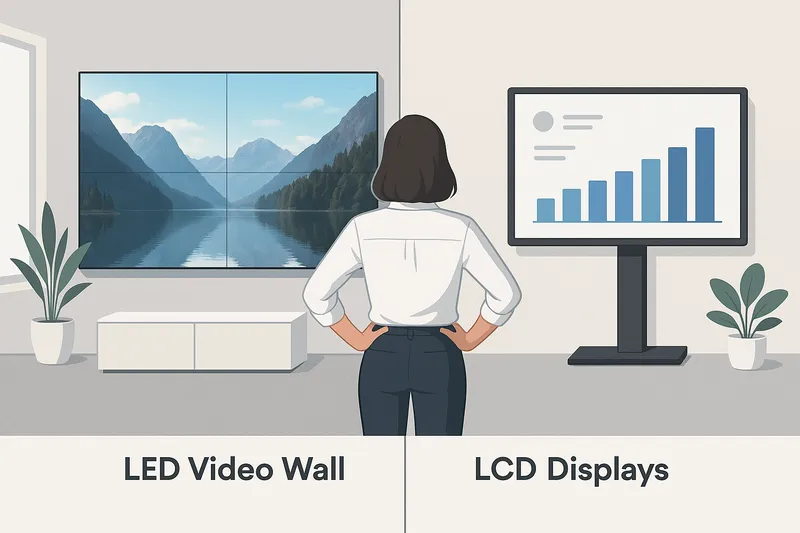
When planning a digital signage installation, one foundational decision is choosing between LED video walls and LCD displays. Both have become ubiquitous in commercial environments but serve different use cases depending on factors like viewing distance, content type, environment, maintenance, and budget. This guide explores the key technical and operational distinctions to help your business select the optimal display technology.
LED video walls consist of multiple LED panels tiled together seamlessly to create one large, highly bright, and often flexible display surface. Each pixel on an LED wall is made of tiny light-emitting diodes (LEDs) that can produce their own light, eliminating the need for a backlight.
LCD (Liquid Crystal Display) signage screens use liquid crystals with a backlight (usually LED backlighting) to create images. These displays are commercially available as single units ranging from small to very large sizes and often used standalone or in tiled arrays where bezels separate screens.
| Aspect | LED Video Walls | LCD Displays |
|---|---|---|
| Pixel Pitch | Extremely fine to coarse (0.7mm–20mm+); defines viewing distance and image resolution | Fixed pixel density per screen; high resolution on smaller sizes, limited by bezel in tiled setups |
| Brightness | Very high (1000–5000+ nits); suitable for bright indoor/outdoor environments | Typically lower (300–700 nits); indoor use only unless specialized outdoor LCD |
| Seamlessness | Virtually bezel-less seams; very smooth, continuous image | Visible bezels between screens in video walls; less immersive |
| Viewing Distance | Optimized at various distances by pixel pitch; closer pixel pitch = closer viewing | Best at typical TV distances; bezels limit immersive large displays |
| Size Flexibility | Highly scalable with custom-sized layouts and curved configurations | Limited by physical screen sizes and bezel gaps; curved setups expensive or uncommon |
Pixel pitch (the distance between pixels) on LED walls directly affects ideal viewer distance:
Example use cases:
| Feature | LED Video Wall | LCD Displays |
|---|---|---|
| Weather Resistance | Often IP65+ rated for outdoor use | Typically indoor use; outdoor LCDs exist but less common |
| Brightness | Extremely high brightness for sunlight readability | Usually insufficient outdoors unless specialized outdoor models |
| Maintenance | Modular LED panels easy to replace outdoors | More susceptible to damage and glare outdoors |
LED video walls are typically superior outdoors due to their brightness and ruggedness. Outdoor LCDs are more niche and often require enclosures.
| Aspect | LED Video Wall | LCD Displays |
|---|---|---|
| Module Replacement | Modular panels can be swapped quickly | Entire screen replacement typically needed |
| Lifespan | 100,000+ hours theoretically, but varies with usage | 50,000–70,000 hours typical lifespan |
| Calibration | Color calibration required periodically | Factory calibrated; may drift over time |
| Power Consumption | Generally higher power for large LED walls | More energy efficient per sq. meter |
Because LED walls are modular, a single failing module can be serviced without disrupting the entire display, reducing downtime in critical applications.
| Use Case | Recommended Technology | Reasoning |
|---|---|---|
| Retail window displays close-up | Fine pitch LED wall or large LCD display | High brightness, close viewing |
| Airport flight information | Mid to coarse pitch LED wall | Visibility from long distances |
| Corporate lobby welcome screen | Ultra-high resolution LCD wall | Sharp content, indoor controlled space |
| Outdoor sports stadium signage | Coarse pitch outdoor LED wall | Large size, sunlight readability |
| Factor | LED Video Wall | LCD Displays |
|---|---|---|
| Best for large, bright environments | Yes | No (unless specialized models) |
| Optimal for seamless, immersive image | Yes | Limited by bezels |
| Suitable for indoor fine detail | Yes (fine pitch panels) and LCD | Yes, particularly smaller sizes |
| Cost-sensitive, smaller installations | Less cost-effective | More cost-effective |
| Long-term maintainability | Modular, easy repairs | May require full replacements |
Deciding between LED video walls and LCD displays ultimately depends on your business’s specific digital signage goals, environment, and budget. For high-impact, scalable, and flexible solutions—especially where outdoor visibility or large seamless displays are critical—LED video walls excel. Where cost, ease of installation, and smaller sizes suffice, LCD displays remain practical and widely deployed.
Regardless of screen type, pairing your hardware with a capable cloud-managed content management system (CMS) like EasySignage enables centralized control, scheduling, and real-time updates. Features like auto-brightness adjustment, health monitoring, and content playback analytics help maximize the value of your chosen display technology.
Choosing the right digital signage display is a vital step toward business success. Careful evaluation of technical specs, operational needs, and budget ensures your digital signage is not only visually impressive but also reliable and cost-effective long term.
Introduction Selecting the right screen is a pivotal step in any digital signage project, directly impacting visibility, reliability, and overall …
Read Article
Complete Guide to Remote Management and Monitoring for Digital Signage Managing multiple digital signage screens across one or many locations can …
Read Article